

Featured in this article
Featured in this article
Indigenous cultures have been using flower essences for thousands of years. Diaries of the first fleet white settlers who arrived in Sydney in 1788 recorded how aboriginal people, if sick, would float Waratahs in water and drink the water for its healing qualities. Aboriginal legends for flowers such as Sturt Desert Pea and Wedding Bush indicate that flower essences were utilised by indigenous people long before the arrival of the white settlers 238 years ago. In Brazil, native people have long been using flower essences and incorporating many different types of water depending on the specific healing quality of the flower being floated in water. For example, when working with a flower that helped release rage and anger, water collected from a thunderstorm was used, whereas if the flower was addressing some very deep-seated emotional issues, they would collect water from a deep well.
In many parts of India, there was a tradition in which women would take a bath in the late afternoon for 40 days after giving birth, using water in which flowers had been floating since the beginning of the day. The bath would realign her emotional, mental and physical wellbeing. There are many parts of India where this is still practised today.
There is a long history of flower essence use in Japan as well, whilst the earliest record of flower essence use goes back over 3,000 years ago to ancient Egypt.

The earliest European recorded history of flower essences was Hildegard von Bingen - an abbess who lived in the 12th century. She would have the nuns in her monastery lay muslin sheets over the flowers overnight. In the morning, the sheets, which had absorbed the dew from the flowers, were wrung out, and the flower-infused moisture was used to treat people experiencing emotional imbalances. If they were very ill the sheets would be wrapped around the person in a hydrotherapy fashion to bring about healing.
Paracelsus, a mighty figure in the history of medicine in the 15th century, also collected the dew of flowers to treat emotional and physical Imbalances.
Unfortunately, so much of this ancient knowledge of flower healing usage was lost over time, which is why we owe so much to Dr. Edward Bach, born 140 years ago, for bringing forward this wonderful healing tradition to the world once more.
Before moving on to Dr Edward Bach, I would like to look at the work of Dr Robert Thomas Cooper (1844–1903), who had a huge influence on Bach.

In the 1890s and beginning of the 1900s Cooper, a very prominent English homoeopathic physician and herbalist developed what he called “Arborivital Medicine”. He believed that a healing force existed within living plants. He would utilise a living branch, still attached to the plant and immerse it in spirit and deliberately exposed to sunlight, a method he called “heliosthening.”
Cooper believed that the life force of the plant was being captured. That is remarkably close philosophically to what Bach subsequently did. Both men used sunlight to extract the life force of the plant in creating their remedies. Cooper used living plant material with water/alcohol extraction, while Bach used flowers which he floated in spring water.
Cooper was apparently so devoted to plants that a contemporary account said he would lie beside a flowering plant for hours, "dragging from it its virtues of healing." Very Edward Bach like. Among the plants he experimented with was Ornithogalum umbellatum, which is very interesting because Ornithogalum umbellatum is also Bach's Star of Bethlehem.
Cooper also collected flowers in the fields, put them in a glass bell jar, which was attached to his belt and walked so the sun was continuously shining on the flowers. Both of Coopers methodologies shed quite a bit more light on exactly how Edward Bach's sun method developed.

Cooper published his heliosthening work in the Homoeopathic World journal and in his influential book, “Cancer and Cancer Symptoms”, published in 1900. After his death, in 1903, John Henry Clarke, one of the most influential British homoeopaths of the period, published an obituary of Cooper in The Homeopathic World. Clarke later wrote The Life of Robert Thomas Cooper and was also involved in the Cooper Club, established after Cooper's death. Cooper’s work was not an obscure idea that disappeared without a trace. His ideas were circulating within the British homoeopathic community decades before Bach developed his flower remedies.
Edward Bach was a close associate of Henry Clark and it was the latter who also published Bach's controversial writings on vaccines and later, his flower remedies. The other key factor showing that Bach was well aware of Cooper's work was that the latter's son, Dr Robert Montagu Le Hunte Cooper (1872–1957), also a homoeopathic physician, who contributed to homoeopathic publications promoting his father's work, was a good friend of Bach. So, Bach wasn't operating in an intellectual vacuum. He emerged from a small, interconnected British homoeopathic world in which Cooper's plant work was already known.

Edward Bach would regularly talk to the local gypsies who visited his local pubs, the only Englishman to do so, picking their brains about their use of plants. He got the idea of using walnut as an essence and knew the healing quality of it from a talk he went to by Rudolf Steiner. Bach was very open to new ideas.
In 1990, I was one of the presenters at the first international Flower Essence conference held in Autrans, France. I felt the very strong presence of Bach during the conference and I knew he was very satisfied to see how his pioneering work was continuing to expand and spreading around the world.

A number of years later, a participant told me that at one of my workshops there was a man in spirit standing behind me imitating my movements, not in a disrespectful way but affectionately. “He has a lot of respect and love for you, but he's having a bit of fun and he's very happy to be here.” The next day I showed the participant a photo of Bach and he excitedly exclaimed “That's him, that's who it was!”
I had a meditation many, many years ago, where myself, Bach and many of the main people making flower essences today were all drawing straws. Bach drew the shortest straw and the reward - or penalty, for that was to come first decades earlier than the rest of us to reawaken the public awareness to the concept of flower essences.
I'm very appreciative that not only Bach, but also others, such as Hildegard von Bingen are still present when I'm doing my work. A few years ago, I received a message in meditation from Hildegard saying that if I went to the ruins of her monastery, there would be something special there for me – which I found, that she wanted me to use to remind me of her presence when making my essences.

After working with the Bush Essences for 40 years, I can clearly see that when there is a need in society, an essence will come down to meet that need. Mulla Mulla, the essence for heat, burning and radiation in all forms - and the key remedy in the Electro combination, was made the year after the Chernobyl disaster. Belarus was directly downwind that day and that country received more radiation than any other.
Every year after Chernobyl, Green Cross measure the radiation levels of children in Belarus. Those with the highest levels of radiation would be taken to the Alps in the summer and neurologists, cardiologists and endocrinologists would try different treatments to reduce their radiation. Electro was the most effective treatment they've ever seen. It released 42% of the nuclear radiation within a two-week period.

In recent years, we've had horrendous fires breaking out in Canada, the northern parts of United States, Spain, Hawaii and certainly Australia. We lost three billion animals and approximately 450 people during the 2019 - 20 bush fire season. People from overseas were traumatised from simply watching footage of the fires, terrified by the power of nature. Once again Mulla Mulla proves so effective in helping both animals and people badly affected by these fires. It also addresses the impact of other forms of radiation including electromagnetic, which is so widespread today. Why didn't Mulla Mulla come through in Bach’s time? Simply because there wasn't the need for it that there is today.

Another example of how flowers are really coming down to help us at this time, is Pink Flannel Flower, which is a wonderful remedy for opening up the heart. It’s a great one for helping children with this and allowing them to heal others through their ability to give love, even when experiencing the worst aspects of humanity.
The two most recent remedies Calophyllum and Sedum, are almost like the spiritual remedies in my other ranges such as the White Light Essences. The former helps people develop a clear connection with spirit, giving them a deeper sense of what needs to be done and the direction in which both they and society need to move. It strengthens their natural leadership qualities, enabling them not only to move forward themselves but also to inspire and guide others to move forward with them. Importantly it also gives great resilience, tolerance and encourages one to get out of their comfort zone.

Sedum helps one to fully ground and anchor their Higher Self, giving one a strong sense of their purpose. It also inspires people to be working for the light, for doing something very positive and powerful on the planet, wanting to be connected with other like-minded light workers.
Regina Nasser, one of my Bush Essence teachers in Natal, Brazil, did a study for the local university on using the Bush Essences to treat a large group of 6-year-old children with learning and behavioural problems. The results were so spectacular that the Natal government had her train 400 health professionals to use the Bush Essences. The government could see the benefit - knowing that the Bush Essences were without side effects, very inexpensive and produced spectacular results.

This is one of the beauties of the Bush Essences - they are a system of healing that anyone can use safely with themselves, friends or family without being a trained healthcare worker. Yet they are also a wonderful tool for practitioners.
My original goal for the Bush Essences was for every household to have them so that children could be brought up with the essences, helping them deal with their challenging times in life. It's a big task, but like Bach and all the others who preceded me I have great passion and drive to spread the awareness of this wonderful modality.
I can envision a future where governments, rather than spending billions on healthcare focused primarily on expensive drugs, surgeries, and other treatments, choose instead to also address the underlying causes of our problems. The focus then would be on fostering greater peace, calm, kindness, purpose, and happiness — qualities that, through the use of flower essences, we can more easily cultivate within ourselves.
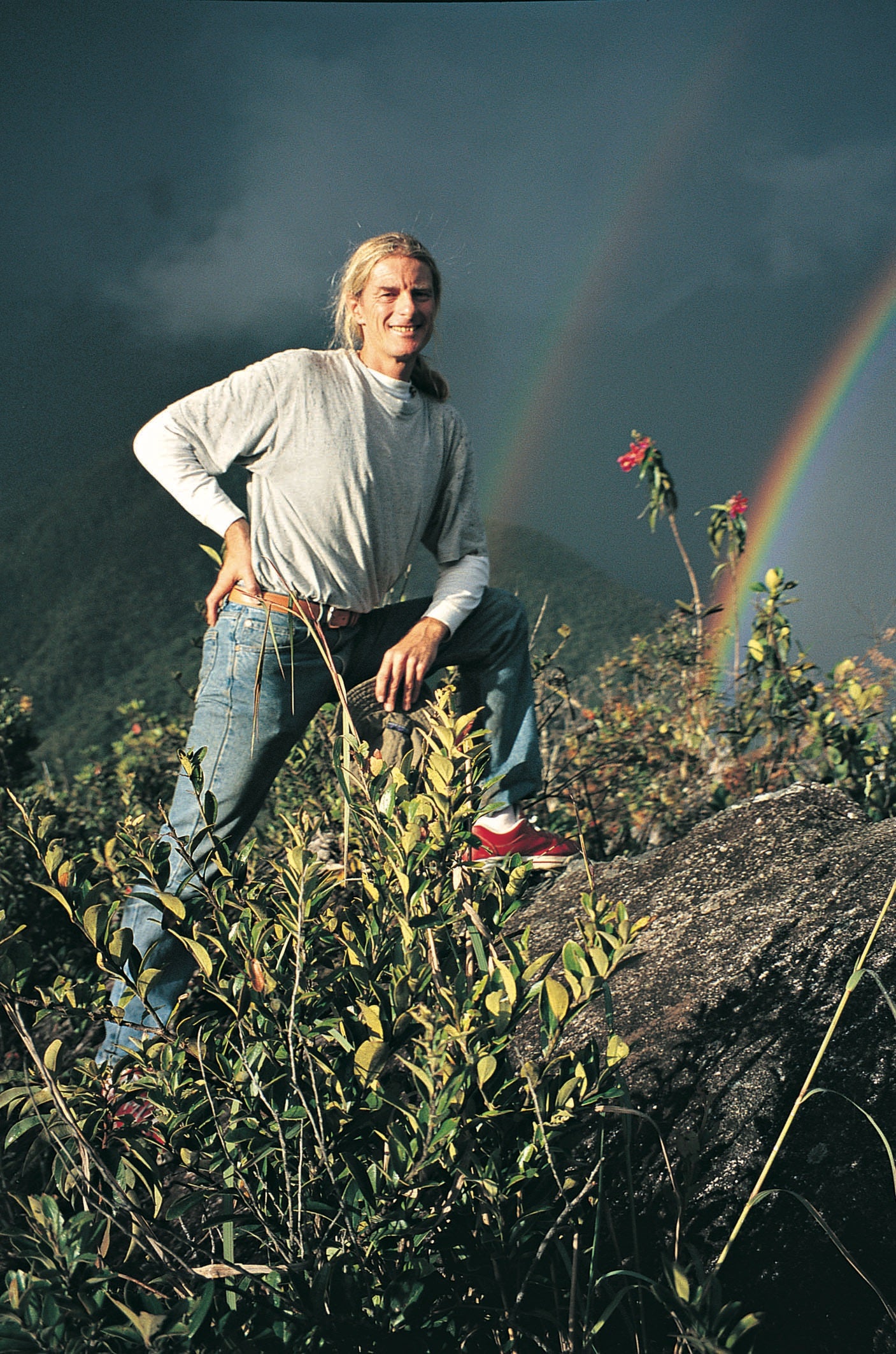
Much Love, Light and Respect

Ian White
Founder & Director


